What a Nurse Coach is, what they do, where they work, and the steps from your RN license to board certification.
A Nurse Coach is a registered nurse who uses coaching skills, within the nursing license, to help people reach the health goals they set for themselves. To become one, hold an active RN or APRN license, complete a Nurse Coach program that includes supervised coaching practice, then sit for the Nurse Coach Board Certification (NC-BC) examination through the American Holistic Nurses Credentialing Corporation (AHNCC).
Where a clinical visit tends to tell a patient what to change, a Nurse Coaching session asks what matters to them and builds from there. It is nursing, practiced in a different posture.
This guide covers what Nurse Coaches do, the nursing theory the role grew from, where Nurse Coaches work, why nurses choose it, and the steps to become one. If you already know you want in, the Integrative Nurse Coach® Certificate Program is where most readers go next.
- A Nurse Coach is an RN or APRN who coaches within nursing practice. The role has a published ANA scope and competencies and a national board certification (NC-BC).
- Nurse Coaches work in hospitals, private practice, corporate wellness, community health, education and specialty practice.
- To become one: hold an active RN license, complete a Nurse Coach program with supervised practice, then sit for the NC-BC examination through AHNCC.
- INCA's Integrative Nurse Coach® Certificate Program has prepared nurses for this role for 15+ years. Graduates are board-certification eligible and practice in 21 countries.
What is a Nurse Health Coach?
The American Nurses Association recognizes Nurse Coaching as a nursing role with its own scope of practice and competencies, published in The Art and Science of Nurse Coaching (2nd ed., 2021). In that document, a Nurse Coach is a registered nurse who partners with a client to promote the client's health and wellbeing through a structured, relationship-based process. "Nurse health coach," "nurse wellness coach" and "Nurse Coach" describe the same licensed role.
Three things in that definition matter in practice.
- It is a nursing role. A Nurse Coach is licensed, accountable to their state Nurse Practice Act, and brings years of clinical judgment into every conversation. Most state practice acts already include health teaching and health counseling in the definition of nursing, which is why coaching fits inside the license rather than beside it.
- It is a partnership. The client sets the agenda. The Nurse Coach listens, reflects, asks, and helps the client find their own next step. Telling people what to do is easy; it also rarely works.
- It is whole-person work. Sleep, food, movement, relationships, stress, meaning and the conditions a person lives with are treated as one picture, because that is how people experience them.
What does a Nurse Coach do?
A typical engagement runs over weeks or months, in person or by video. A first session often starts with a structured self-assessment such as the Integrative Health and Wellness Assessment, a validated instrument that maps how a client sees their own health across several dimensions and shows where they want to begin. From there the work is conversational: the client names a goal, the Nurse Coach helps them break it into something they can do this week, and each session checks what happened, what got in the way and what to try next.
The skills behind that look simple from the outside and take practice to do well: open questions, reflective listening, motivational interviewing, strengths-based framing, and knowing when to be quiet. For a feel of the questions themselves, see 30 strengths-based coaching questions to ask your clients.
What a Nurse Coach does not do is diagnose or prescribe inside the coaching relationship. Those limits come from your state's Nurse Practice Act, and they are part of why clients trust the role: the Nurse Coach is there for the client's goals, not to manage their chart.
Nurse Coaching is not new: the nursing theory behind it
The role has a lineage that predates the credential by decades. Betty Neuman described the person as a whole system seeking balance between internal and external environments, and built an assessment around patient-identified challenges. Dorothea Orem's self-care model treated the nurse-patient relationship as interactive, with health promotion based on the person's own capabilities. Patricia Benner described the partnership as joint decision-making that draws on the person's own wisdom.
Later work made the coaching posture explicit. Schenk and Hartley defined the Nurse Coach role as "an expanded professional interaction based on mutual respect of the knowledge and skills that both nurse and client bring to the situation." Albert Bandura's concept of self-efficacy, a person's belief in their ability to manage their own health, became the mechanism: the Nurse Coach's questions build it, and it is what sustains a change after the sessions end.
In 2013 the American Nurses Association published the first edition of the Nurse Coaching scope and competencies, and AHNCC opened board certification. The theory has since been formally analyzed in the Journal of Holistic Nursing, and a growing body of outcome research, including a 2025 randomized controlled trial of a holistic Nurse Coaching intervention in diabetes, is testing what the role does for clients.
Why healthcare needs Nurse Coaches now
The CDC reports that most American adults live with at least one chronic condition, and that a large share of that burden is linked to behaviors that can change: how people eat, move, sleep, manage stress and use tobacco and alcohol. The health system is built to treat the conditions; it has very little capacity to help people change the behaviors. That gap is the job.
Nursing is the profession positioned to fill it. There are more than four million registered nurses in the United States, already trusted, already in every setting where people receive care, and already taught whole-person assessment. Health systems use Nurse Coaches in chronic-condition and care-transition programs, employers hire them for workforce health, and starting in 2027 Medicare pays for health and well-being coaching. How to integrate Nurse Coaching into your organization covers the employer side.
Nurse Coach, nurse health coach, nurse life coach: what the names mean
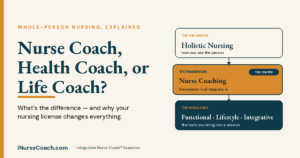
You will see all three. In practice they describe the same licensed role seen from different angles. "Nurse health coach" emphasizes health goals; "nurse life coach" emphasizes life direction. What separates a Nurse Coach from a health coach or a life coach is not the topic but the license: the coaching happens inside nursing practice, with a nurse's assessment skills and accountability behind it.
| Nurse Coach | Health coach | Life coach | |
|---|---|---|---|
| License | Active RN or APRN license | No license required | No license required |
| Scope | Nursing practice under the state Nurse Practice Act, with clinical knowledge and assessment skills | Wellness and behavior change goals | Life direction, goals and motivation |
| Board certification | NC-BC or HWNC-BC (AHNCC) | NBC-HWC (NBHWC) | ICF credentials (ACC, PCC, MCC) |
| Where they work | Hospitals, health systems, clinics, interprofessional practices, private practice, corporate wellness | Wellness programs, health plans, private practice | Private practice, corporate settings |
For a longer side-by-side look, read Nurse Coach vs. health coach vs. life coach.
Where do Nurse Coaches Work?
Nurse Coaches work wherever nurses already work, and in a few places nurses have not traditionally been.
- Hospitals and health systems. Chronic-condition programs, care transitions, population health teams and employee wellbeing programs all use Nurse Coaches. Some nurses never leave their current employer; they bring coaching into the unit they already work on and become the wellness champion for other nurses. Some systems now enroll groups of their own nurses in Nurse Coach education for exactly this reason.
- Interprofessional practices. Nurse Coaches work alongside physicians, nurse practitioners, functional medicine clinicians, nutrition professionals, physical therapists and mental health providers, often as the person who helps a client act on everyone else's advice.
- Private practice. Many graduates build a practice of their own: one-to-one coaching, group programs, workshops, often by video. It can be a full business or a few clients alongside a staff job. How to start a Nurse Coaching business covers the path, and Nurse Coach jobs and Nurse Coach salary cover the market.
- Corporate wellness. Employers hire Nurse Coaches for health assessments, coaching programs and on-site education.
- Community and public health. Community health centers, faith communities, school systems and public health campaigns, often with the populations that receive the least preventive care.
- Education. Nursing schools and continuing education programs, where Nurse Coaches teach and design curricula.
- Specialty practice. Some Nurse Coaches add a nursing specialty, such as functional medicine nursing, lifestyle medicine, cannabis nursing or end-of-life care, and build their practice around it.
Why nurses choose Nurse Coaching
We have taught this role for more than fifteen years, and the reasons nurses give for choosing it have been consistent.
- To practice the nursing they were taught. Most nurses learned whole-person care in school and then spent their careers with twelve minutes per patient. Coaching gives that care room.
- To work on their own terms. Private practice, part-time coaching, a role inside a health system, or a mix. Graduates of our program practice in 21 countries.
- To get their own health back. Nurse Coaches learn the same practices they offer clients, and many describe the program as the first time in years they attended to their own wellbeing. As one holistic Nurse Coach put it, the challenge is "our ability to give and contribute to society and also to find ways to care for and coach ourselves so we do not burn out."
- To change what healthcare does, from the inside. Medicare coverage of health and well-being coaching, employer demand and Magnet recognition of the NC-BC credential all point the same direction: this is a role the system is making room for.
- To be changed by the work. Meg Jordan, PhD, RN, of the California Institute of Integral Studies, describes coaching as adopting "a new way of being with people," and says that being a coach "changes one from the inside out."
- To hold a credential that means something. Nurse Coach board certification is a national credential with published competencies, an examination and continuing education requirements, administered by AHNCC.
Do you need board certification?
Certification is voluntary; your license is what allows you to practice. But the NC-BC credential tells clients, employers and other clinicians that an independent body has verified your competence against a published standard, and it is increasingly what employers ask for. AHNCC offers three related credentials: Nurse Coach (NC-BC), Holistic Nurse (HN-BC), and for nurses who hold both, Health and Wellness Nurse Coach (HWNC-BC). The Nurse Coach certification guide covers eligibility, timing and cost for each.
How to Become a Nurse Coach
Becoming a Nurse Coach takes six steps:
- Hold an active RN or APRN license.
- Choose a Nurse Coach program.
- Complete the program and the practicum.
- Sit for Nurse Coach board certification.
- Decide where you will practice.
- Keep growing.
1. Hold an active RN or APRN license
Nurse Coaching is a nursing role, so an active license is the starting point. Both ADN- and BSN-prepared nurses are eligible for the program and for board certification. AHNCC also expects nursing practice experience, and that is broader than it sounds: hours inside a Nurse Coach program count, and practice hours are not limited to paid work. Licensed outside the United States? You are likely eligible for NC-BC; confirm with AHNCC.
If you are an LPN or LVN, or not yet licensed, the path is different. Nurse Coaching programs for LPNs and LVNs explains what is open to you now.
2. Choose a Nurse Coach program
Look for four things: alignment with the ANA scope and competencies, accredited contact hours, supervised practice with real clients built into the curriculum, and graduates who are eligible to sit for board certification. How to choose a Nurse Coach program gives you the questions to ask any school, including ours.
The Integrative Nurse Coach® Certificate Program is self-paced within a cohort: you move through the material on your own schedule while learning alongside the same group of nurses, with faculty mentorship every other week and a supervised practicum with real clients. It carries 294+ contact hours, and graduates are board-certification eligible.
3. Complete the program and the practicum
The practicum is where the role becomes real. You coach clients, bring your sessions to your faculty mentor and small group, and build the confidence to hold a conversation without steering it. Some practice clients come from INCA's client database, and you learn to find the rest yourself, which is a skill every practicing Nurse Coach needs. Most graduates say this is the part they would not skip.
4. Sit for Nurse Coach board certification
After the program, you can apply to AHNCC to take the Nurse Coach Board Certification (NC-BC) examination. INCA is an AHNCC sponsoring organization, so our graduates receive a discount on the examination fee. The credential is accredited by the Accreditation Board for Specialty Nursing Certification and recognized by the ANCC Magnet Recognition Program. The certification guide walks through eligibility, timing and cost.
5. Decide where you will practice
Some graduates coach inside the organization they already work for. Others open a practice, join a corporate wellness team or move into community health. The decision usually becomes clear during the practicum, when you notice which clients and settings you look forward to.
6. Keep growing
NC-BC is renewed with continuing nursing education. Many Nurse Coaches add a specialty course, join the alumni community, or return as faculty mentors. The learning does not stop at graduation, which is one of the better things about the role.
Is Nurse Coaching right for you?
It tends to be a fit for nurses who are good at listening and tired of not being allowed to use it; who want a credential rather than a weekend workshop; and who would like their own health to improve along the way. It tends not to be a fit for anyone who wants to leave nursing behind, because it is nursing.
Graduates have written about the decision from different points in their careers: Would I become a Nurse Coach again?, How I became an Integrative Nurse Coach® and what a client sees from the other side of the conversation. If you would rather experience it than read about it, you can book a free Nurse Coaching session with a current student.
Common questions about becoming a Nurse Coach
Is a Nurse Coach a real nursing role?
Yes. The American Nurses Association publishes the scope and competencies for Nurse Coaching in The Art and Science of Nurse Coaching (2nd ed., 2021), and the American Holistic Nurses Credentialing Corporation administers the Nurse Coach Board Certification (NC-BC) credential.
Do I need to be an RN to become a Nurse Coach?
Nurse Coaching is practiced under a nursing license, so an active RN or APRN license is required for the Integrative Nurse Coach® Certificate Program and for NC-BC. LPNs, LVNs and nursing students can start with INCA's specialty programs.
How long does it take to become a Nurse Coach?
The Integrative Nurse Coach® Certificate Program is self-paced within a cohort, and most nurses complete it in under a year while working. Board certification follows once you meet AHNCC's practice-hour requirement; the hours you accumulate during the program count.
What is the difference between a Nurse Coach and a health coach?
The license. A health coach may have no clinical background; a Nurse Coach brings nursing assessment, judgment and accountability into the coaching relationship, and practices within their state Nurse Practice Act.
Can Nurse Coaches diagnose or prescribe?
Within the coaching relationship, no. What a nurse may do outside of coaching depends on their license and their state's Nurse Practice Act.
Where do Nurse Coaches work?
Hospitals and health systems, private practice, corporate wellness, community health, education and specialty practices such as functional medicine nursing. Graduates of INCA's program practice in 21 countries.
Ready to become a Nurse Coach?
The Integrative Nurse Coach® Certificate Program has prepared nurses for this role for more than fifteen years. Self-paced within a cohort, 294+ contact hours, faculty mentorship every other week, and graduates who are board-certification eligible.
Explore the INCCP → Book an admissions call →Sources
- American Nurses Association. The Art and Science of Nurse Coaching: The Provider's Guide to Coaching Scope and Competencies, 2nd ed. (2021).
- American Holistic Nurses Credentialing Corporation. Professional Nurse Coach Role: Core Essentials and Competencies (2023).
- Moore, Avino and McElligott. Analysis of the Theory of Integrative Nurse Coaching. Journal of Holistic Nursing 40(2) (2022).
- McElligott, Eckardt, Dossey, Luck and Eckardt. Instrument development of the Integrative Health and Wellness Assessment. Journal of Holistic Nursing 36(4) (2018).
- Bilgehan et al. The effect of a holistic nurse coaching intervention on glycemic control, diabetes self-management, and empowerment: a randomized controlled trial. BMC Nursing 24 (2025).
- Schenk and Hartley. Nurse Coach: Healthcare Resource for this Millennium. Nursing Forum (2002).
- Centers for Disease Control and Prevention. Chronic disease.

Karly Mertz
Karly Mertz, MSN, RN, NC-BC is a Board-Certified Nurse Coach and serves as Nurse Planner and Program Coordinator at the Integrative Nurse Coach® Academy. She holds a Master of Science in Advanced Holistic Nursing from Florida Atlantic University. With over a decade of experience as a surgical and cardiac nurse, Karly brings a grounded clinical background to her holistic practice. After completing the Integrative Nurse Coach® Certificate Program through INCA, she fully embraced her calling to support healing through a whole-person, heart-centered lens. Karly has led group Nurse Coaching sessions for pregnant and postpartum mothers in her community, incorporating holistic modalities such as guided meditation, journaling, EFT tapping, and sound healing.