
To start a Nurse Coaching business, you complete a recognized Nurse Coach education program, confirm your scope of practice under your own state's Nurse Practice Act, set up the business legally (entity, EIN, business banking, coaching-specific liability insurance, client agreements), design and price one signature offer, build a simple brand and a three-page website, choose one or two marketing channels you can sustain, and work a written 90-day launch plan. Most nurses who follow that sequence reach a first paying client somewhere between month two and month four.
You already have the part that cannot be taught in a weekend. You know how to assess a whole human being. You know how to sit with someone on the worst day of their life and stay steady. You know how to notice the thing nobody said out loud.
What you probably were not taught is how to choose a business entity, price a coaching package, or answer the question "so what do you do?" in one clear sentence.
That gap is the entire reason most Nurse Coaching businesses stall before they start. Not a lack of skill. Not a lack of caring. A lack of a plan, in writing, in the right order.
This guide walks through that order. Nine steps, in the sequence that actually works, with the numbers, the legal checkpoints, the named tools, and the honest answers most articles skip. By the end you will know exactly what to build, what it costs, and roughly how long it takes.
If you are still deciding whether this path is for you at all, start with what is a Nurse Coach and come back. If you already know, keep reading.
What a Nurse Coaching business actually is
A Nurse Coaching business is a private practice in which a registered nurse partners with clients to help them reach their own health and wellbeing goals, working under an RN license, and billing the client directly in most cases.
Three things define it structurally:
- You own the relationship. You guide, educate, and hold space for change, with your nursing assessment running underneath all of it.
- You set your own model. Sessions, packages, and programs, priced and structured by you.
- You carry your own infrastructure. Entity, insurance, scheduling, payments, agreements, and marketing are yours to build.
Here is the part worth being precise about, because it shapes everything downstream: Nurse Coaching is nursing. It is not a departure from your profession or a second career pasted on top of it. It is your clinical education, your assessment skills, and your years with real patients, applied a different way. Nurse Coaching also has its own defined scope and competencies, which is worth knowing because it is what separates this from unregulated coaching. The American Nurses Association publishes The Art and Science of Nurse Coaching: The Provider's Guide to Coaching Scope and Competencies, and its Nurse Coaching competencies are reviewed and approved through ANA's Affirmation of Focused Practice Competencies program. The American Holistic Nurses Credentialing Corporation (AHNCC) builds on that in Professional Nurse Coach Role: Core Essentials and Competencies, which organizes 143 competencies under 17 ANA standards and forms the basis of the NC-BC examination.
Everything you have learned comes with you. What changes is the shape of the work. As a coach you are not diagnosing, prescribing, or treating. You are not writing care plans for a chart. Your client sets the agenda, your client has a care team for clinical management, and your job is to help them close the distance between what they know they should do and what they actually do.
Nurse Coach vs. health coach: what the license actually buys you
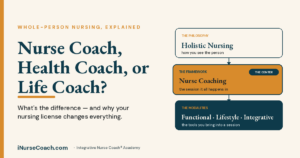
This is your competitive advantage, so it is worth seeing side by side.
| Nurse Coach | Health or life coach | |
|---|---|---|
| Licensure | Active RN license, required | None required |
| Clinical education | Nursing degree plus years of direct patient care | Varies widely, often none |
| Reading clinical context | Can read a lab panel, recognize a red flag, and understand what a new diagnosis means to a frightened person | Not qualified to |
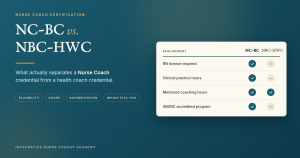
| Board certification | NC-BC through AHNCC | NBC-HWC through NBHWC |
| Governed by | Your state Nurse Practice Act, plus ANA-affirmed Nurse Coaching competencies and the AHNCC Core Essentials | No statutory scope of practice |
| Referral judgment | Trained to recognize when something needs a clinician, and how to hand it off | Limited |
If you want to go deeper, we cover it in Nurse Coach vs. health coach vs. life coach and in Nurse Coaching through a nursing lens.
Is there real demand for Nurse Coaches in 2026?
Two data points worth holding side by side.
First, the coaching market is growing. Precedence Research estimates the global health and wellness coaching market at roughly $21.6 billion in 2026, growing at about 7 percent annually. Treat vendor market-sizing with appropriate skepticism, but the direction is not in dispute: chronic disease, employer wellness spending, and consumer interest in prevention are all rising.
Second, and more relevant to you personally, the nursing workforce itself is under strain. The Bureau of Labor Statistics reports a median RN wage of $93,600 as of May 2024 with about 5 percent employment growth projected through 2034. Steady, but for a great many nurses the issue is not pay. It is exhaustion, moral distress, and the sense of having been pulled away from the reason they became a nurse.
Nurse Coaching sits precisely at that intersection. Growing client demand for whole-person support, and a large population of experienced nurses looking for a sustainable way to keep practicing. If you want to see what Nurse Coaches earn in practice, we keep a working breakdown in our Nurse Coach salary guide.
Step 1. Do the mindset work before the business work
This will feel like the skippable step. It is not, and skipping it is why capable nurses end up with a beautifully designed website and zero clients.
Most nurses do not stall on tactics. They stall on identity. Moving from "nurse who helps everyone" to "practice owner who serves a specific someone" surfaces three real blocks:
- "Who am I to charge for this?" Twenty years of clinical excellence, and somehow it does not feel like enough. This is imposter syndrome wearing a professional disguise, and it responds to evidence rather than pep talks. Write down what you actually know how to do.
- "Marketing is not me." Nurses are taught to serve, so selling can feel like a betrayal of that. The reframe that works: marketing is how the people who need you find out you exist. Silence is not humility. It is just silence.
- "I need one more credential first." Sometimes true. Usually a delay tactic. Be honest with yourself about which one it is.
Name your blocks on paper. Write the counter-evidence next to each one. Then move on, because you will meet these again at every stage, and recognizing them quickly is the actual skill. We go deeper in imposter syndrome, Nurse Coach.
Step 2. Choose a niche you can actually serve
"I help people get healthier" is not a niche. It is a shrug. It gives a potential client no reason to choose you and gives you no way to make a single decision about pricing, marketing, or services.
A workable niche sits where three circles overlap:
- Passion. What could you talk about at 9pm after a twelve hour shift?
- Credibility. Where does your clinical history give you unfair advantage? Twelve years in oncology. Cardiac rehab. Labor and delivery. NICU. That history is your proof.
- Demand. Are these people actively looking for help, and can they pay for it?
The overlap is usually more specific than feels comfortable. "Women in their fifties navigating a new type 2 diabetes diagnosis while caring for aging parents" is a niche. It also tells you exactly what to write, where to show up, and what to charge.
From there, draft two more pieces of language: a unique selling proposition (what makes you a specific, credible choice) and a value proposition (the transformation your client actually wants). They nest into one sentence.
"I help [specific person] achieve [specific outcome] through [your approach], so they can [the transformation]."
Say it out loud. If you cannot say it without editing mid-sentence, it is not finished.
Two fears about niching, both worth addressing. You are not turning away everyone else, you are simply speaking clearly to someone. And you are not locked in forever. Most Nurse Coaches refine their niche in year two with real client data. Start specific, adjust later. More on this in niche down, Nurse Coach.
Step 3. Confirm your scope of practice in your own state
This is the step most business courses save for last or skip entirely, and that is a mistake. For Nurse Coaches, scope is the single biggest source of ongoing anxiety, and resolving it early lets every later decision rest on stable ground.
It is also the step generic courses get wrong, because scope is not national. It is set state by state. Your state legislature passes a Nurse Practice Act. Your state Board of Nursing then writes the rules that interpret it. What an RN may and may not do in Florida is not identical to Oregon. Anyone who tells you there is one universal answer has not read fifty statutes.
How to actually do this
- Find your Nurse Practice Act. NCSBN maintains a state-by-state lookup that routes you to your board's statute or administrative code. Read the definition of nursing practice and any language about health teaching, counseling, and wellness.
- Check your board's position statements and FAQs. Some boards have published guidance specifically on coaching, wellness services, or nurses in independent practice. This is where the useful specifics live.
- Use a decision framework for gray areas. NCSBN's Scope of Practice Decision-Making Framework walks you through whether a given activity is prohibited by law, supported by evidence, and within your own demonstrated competence. Use it before you offer any modality you are unsure about.
- Document what you find. Write down the citation, the date you checked, and your conclusion. If a question ever arises, "I researched this and here is what I found" is a very different position from "I assumed."
What stays the same, and what changes
Stays the same: you are a nurse. You practice under your license. Your assessment skills, your clinical knowledge, your professional ethics, your documentation habits, and your obligation to recognize when something needs escalation all come with you.
Changes: in the coaching relationship you do not diagnose, prescribe, treat, or order and interpret labs unless you hold separate licensure to do so. Your client leads the agenda. Your client's clinical care belongs to their care team, and part of your value is knowing when and how to refer.
Step 4. Set up the legal foundation
Nurses often dread this step and then find it is the fastest one. Most of it is paperwork with clear instructions.
Choose a business structure
The SBA's guide to business structures is the authoritative starting point. In practice, most solo Nurse Coaches land in one of three places:
- Sole proprietorship. Free, instant, no filing. No liability separation between you and the business. Fine for testing, weak for a practice you intend to grow.
- Single-member LLC. The common choice. Creates a legal separation between personal and business assets, costs roughly $50 to $500 depending on your state, and is straightforward to file yourself. Note that a few states restrict certain professional practices to a PLLC, so check your Secretary of State's rules.
- S-corp election. Not a separate entity, a tax election an LLC can make. It can reduce self-employment tax once profit is meaningful, and it adds payroll complexity. Most coaches revisit this in year two or three with an accountant, not at launch.
Your legal launch checklist
- Business structure chosen and registered with your state
- EIN from the IRS. Free, issued immediately, and it takes about ten minutes online. Use IRS.gov directly and never a site that charges you for it.
- Business bank account, opened with your EIN and formation documents. Keeping business and personal money separate is the single most important financial habit you will build.
- Professional liability insurance that covers coaching. Your clinical malpractice policy almost certainly does not. Ask your carrier in writing. Carriers that write coverage for Nurse Coaches and wellness professionals include CM&F Group, HPSO, NSO, and Berxi. Budget roughly $200 to $500 per year.
- Client agreement, informed consent, and intake forms. These protect both you and your client. Adopt privacy-conscious, HIPAA-aware communication practices from the first session.
- Local business license or occupational permit if your city or county requires one
- A HIPAA position. If you handle protected health information or contract with covered entities, know your obligations. If you do not, know why not, in writing.
- Simple bookkeeping from day one, even if it is a spreadsheet
The whole list is achievable in two to three weeks of evenings. The reason to finish it early is that every downstream decision, from pricing to your website, gets easier once you know what your business legally is.
The scope and legal steps are the two most nurses get stuck on. Launching Your Nurse Coaching Business & Private Practice walks you through your own state's Nurse Practice Act and hands you the full legal launch checklist, with a directory of every state Board of Nursing.
See what you'll build →Step 5. Price your services like a business owner
Pricing is where nurses lose the most money, and the cause is almost never math. It is guilt. Helping professionals undercharge themselves out of business more often than any competitor pushes them out.
Work backward from your income goal
Start from the wrong end on purpose. Not "what do other coaches charge" but "what do I need this to produce."
Decide the take-home income you need. Add roughly 25 to 30 percent for self-employment tax, then add your annual business expenses. That is your required gross revenue.
Now divide by realistic capacity. If you want $60,000 take-home, your gross target is closer to $85,000. At 15 client sessions a week for 46 working weeks, that is about 690 sessions, or roughly $123 per session. If 15 sessions a week is not realistic alongside a clinical job, your per-session number has to go up or your income goal has to come down. The math is not cruel, it is just honest, and it is far better to meet it on a spreadsheet than in month seven.
Then sanity-check the number three ways
- Value-based. What is the transformation worth to the client?
- Cost-based. What does it actually cost you to deliver, including your unpaid admin time?
- Market-based. What do comparable coaches in your niche charge?
Use all three together. Any one alone will mislead you.
What Nurse Coaches actually charge
| Model | Typical range | Notes |
|---|---|---|
| Single session, independent | $100 to $400 per hour | Wide range by market, niche, and experience |
| Three-month signature package | Low thousands | The most common structure, and the one that produces better client outcomes |
| Group program | Lower per person, higher per hour | Six to twelve people in one slot, with peer support built in |
| Employed Nurse Coach role | Roughly $77,000 to $107,000 per year | Varies considerably by source, region, and experience |
Most successful practices sell three to six month packages rather than single sessions, because real behavior change takes months and package revenue is predictable. Group programs are worth building once you have run a few one-to-one clients. See the group coaching model.
Perpetual discounting, "free forever," and undercharging quietly end more coaching practices than any competitor does. Every discount you offer to avoid an uncomfortable conversation is a payment you make to your own guilt.
Set up simple bookkeeping and tax planning from day one. Many solo practitioners set aside roughly 25 to 30 percent for taxes and pay quarterly estimates rather than facing one large April bill.
Set the number, then practice saying it out loud until your voice stops changing. If you flinch when you say your price, the client hears the flinch.
Step 6. Design one signature offer and map the client journey
New coaches build menus. Menus confuse buyers and exhaust the coach. Build one signature offer instead, or at most two: a single session and a signature package.
Define it in five parts: who it is for, the outcome it moves them toward, how long it runs, what is included session by session, and the price.
Then map the whole client journey, because the coaching itself is only the middle of it. Seven stages:
- Awareness. How does this person find out you exist?
- Consideration. What do they read, watch, or receive that builds trust?
- Discovery call. A structured twenty to thirty minute conversation, scripted, ending in a clear yes, no, or not yet. Write the script. Do not improvise this. A well-designed discovery call with a light, honest structure is how interest becomes enrollment without pressure.
- Onboarding. Agreement signed, payment collected, intake completed, first session scheduled. Automate as much as you can.
- Coaching. The work itself, with a repeatable session structure grounded in Nurse Coaching competencies.
- Completion. A closing session, progress reviewed, testimonial requested. Ask at the moment of peak gratitude, not three months later.
- Continuation. Renewal, a maintenance option, or a warm referral request.
Stages 3, 4, and 6 are where most practices leak revenue, and all three are fixable with a written script and a few templates.
Your starter tech stack
Pick one tool per category and stop. You can always upgrade.
- Scheduling: Calendly, Acuity, or Practice Better
- Video: Zoom, Google Meet, or Doxy.me
- Payments: Stripe, Square, or PayPal Business
- Client management: Practice Better or Paperbell, or a simple organized folder system to start
Step 7. Build a brand and a small, honest online presence
You are the brand. Personal branding for a Nurse Coach is not a logo, it is clarity about your values, your personality, and your ideal client, expressed consistently. For a solo practice, authentic beats polished every time, and a slick site with vague copy converts worse than a plain site with a clear promise.
Pick three brand personality words you want a client to feel after reading your page. Warm, direct, credible. Grounded, practical, hopeful. Then write everything so those three words are true. Cover the visual basics once: one color palette, one or two fonts, consistent imagery.
Secure a domain, pick an approachable platform (Squarespace, Wix, WordPress, Canva Sites, or Showit), and build a three-page starter website:
- Home. Who you help, what changes, one clear next step.
- About. Your nursing story, told for the client's benefit rather than as a resume. Credentials matter. Lead with the human.
- Work with me. Your signature offer, the price or the price range, and a way to book a discovery call.
Add a professional email address at your own domain and one social profile you will actually maintain. You do not need a large site to launch. You need a clear one, and it can be live in a weekend.
Step 8. Choose one or two marketing channels, deliberately
Marketing overwhelms nurses when they imagine "selling." Reframe it: marketing is how the people you are meant to serve find out you exist. It runs on the know, like, and trust principle, which is the same thing you have been doing at the bedside for years.
The mistake is trying to be everywhere. Choose based on three constraints: where your niche already gathers, what format you can sustain, and how many hours a week you truly have. Then go deep on one or two rather than spreading thin.
- Referral relationships. The highest-converting channel for Nurse Coaches, and the most underused. Ten warm conversations with physicians, therapists, dietitians, pelvic floor PTs, or local wellness practitioners will usually outperform six months of posting. See growing your practice through interprofessional collaboration.
- Speaking and workshops. Libraries, employers, faith communities, disease-specific support groups. You are a nurse, which means you are trusted in the room before you open your mouth.
- Email. Slow to build, entirely yours, and consistently the best converter over time.
- One social platform. Choose where your niche actually is, not where the loudest coaches are.
- Local and community presence. Health fairs, professional associations, practitioner networks. Unglamorous and effective.
Build a realistic 30-day content plan and a simple referral system. Consistency on one channel beats burnout across five.
And to answer the question directly, because it comes up constantly: yes, you can build a full practice with no social media at all. Plenty of Nurse Coaches do, on referrals, speaking, and email alone.
Step 9. Put it on a 90-day calendar
Steps 1 through 8 build the components. Step 9 puts them on a calendar, because a plan without dates is a wish.
| Phase | What gets done |
|---|---|
| Days 1 to 30 FOUNDATION |
Niche statement written. State scope research completed and documented. Entity registered, EIN obtained, bank account opened, insurance confirmed. Client agreement and intake drafted. Pricing set. |
| Days 31 to 60 VISIBILITY |
Three-page website live. Signature offer written and published. Ten referral conversations booked. Discovery call script written and rehearsed. First piece of content published. |
| Days 61 to 90 CONVERSION |
Discovery calls happening on a schedule. First paid client onboarded. Session structure tested and adjusted. Metrics tracked. |
Track three to five simple metrics and no more: conversations had, discovery calls booked, calls converted, revenue collected, hours worked. Set a rhythm for testimonials and referrals, and pre-plan your response to the obstacles that predictably show up.
Then pick one thing from the Foundation list and schedule it in the next seven days. Not "soon." A date. The goal is not a perfect launch. It is a real one.
For more on the launch itself, see the business of Nurse Coaching: tips for a successful launch and seven strategies for growing a nurse health coach business.
What it actually costs to start
Realistic first-year numbers for a solo practice, assuming you do the setup yourself:
- State entity registration: $50 to $500 depending on your state
- EIN: free
- Professional liability insurance covering coaching: roughly $200 to $500 per year
- Domain and hosting: $100 to $250 per year
- Scheduling and video: $0 to $300 per year, and free tiers are genuinely fine at first
- Email marketing: free up to a few hundred subscribers
- Bookkeeping: $0 with a spreadsheet, or about $200 to $400 per year for software
- Client agreement review by an attorney: $300 to $800 as a one-time cost, and worth it
Most Nurse Coaches launch for under $1,000 in year one, and many come in under $700 before optional legal review. The expensive path is the one where you buy tools before you have clarity. Get the plan first. The tools are cheap once you know what you need them to do.
Can Nurse Coaches bill insurance? The honest answer
This question comes up in every single cohort, so here is the direct version.
An RN cannot independently bill most insurers for coaching services. RNs are generally not credentialed as independent providers, and coaching as such is not a covered benefit under most plans. Anyone selling you a course that promises easy insurance reimbursement for RN coaching is overselling.
What is actually true:
- Most successful Nurse Coaching practices are cash-pay. Clients pay directly, usually for packages. This is the norm, not a consolation prize, and it keeps you out of a great deal of administrative burden.
- Some codes exist in specific contexts. Chronic care management, behavioral health integration, and wellness visit codes can involve RN time when billed under a supervising provider within a practice. We break this down in CPT codes for Nurse Coaches and in Nurse Coaches and the Medicare annual wellness visit.
- Nurse practitioners have more options, since NPs bill as providers in most states, which changes the picture considerably.
- Employers, health systems, and organizations do pay. Contracting with an employer wellness program or a medical practice is often a faster path to steady revenue than credentialing ever would be.
- HSA and FSA funds can sometimes be used by clients for wellness services, which is worth knowing when you discuss price.
Plan for cash-pay. Treat contracts and codes as expansion opportunities once your practice exists.
How long until you have paying clients?
Nobody publishes this honestly, so here is what we see.
Nurses who complete their legal and pricing setup and then hold ten to fifteen real conversations per month typically land their first paid client somewhere between month two and month four. A practice that replaces meaningful clinical income usually takes twelve to twenty-four months of consistent effort.
The variable that matters most is not talent or credentials. It is the number of conversations you have with people who might need you. Coaches who talk to people get clients. Coaches who build assets in private do not.
Which is also why the mindset work in Step 1 is not a warm-up. It is the thing that determines whether Steps 2 through 9 ever get used.
The step almost everyone skips
Write the plan down.
Not in your head. Not across nine browser tabs and a notes app. One document, with your niche statement, your documented scope research, your entity and legal checklist, your actual prices, your signature offer, your client journey, your website plan, your chosen channels, and your dated 90-day calendar.
A business plan for a Nurse Coaching practice does not need to impress a bank. It needs to be specific enough that on a tired Tuesday you can open it and know what to do next. That is the whole function. Nurses who write it down launch. Nurses who keep it in their heads keep researching.
Why "just add a business course" isn't enough
Many Nurse Coach programs advertise a business component, often a "free bonus course" bolted onto the clinical curriculum. The problem is depth and sequence. A pile of modules on marketing tactics does not help if scope of practice is treated as an afterthought, if the legal foundation is vague, or if you finish with information but no actual plan you can execute.
A genuinely comprehensive business program does four things a bonus course rarely does:
- Puts scope of practice and legal foundations early, so every later decision rests on solid ground.
- Grounds the teaching in the profession's own standards, the ANA Nurse Coaching scope and competencies and the AHNCC Core Essentials, rather than generic entrepreneurship advice.
- Produces a real, keepable deliverable, a written business and launch plan, rather than quizzes to pass.
- Awards contact hours and a Certificate of Completion you can note on your website, LinkedIn, and email signature.
Where Launching Your Nurse Coaching Business & Private Practice fits
Everything above is the outline. Doing it is the work, and doing it alone is why so many nurses stall.
Launching Your Nurse Coaching Business & Private Practice is the Level 4 professional practice branch of the Integrative Nurse Coach® Certificate Program that takes you from the end of Practicum to a finished, written Business Launch Plan. Self-paced, with lifetime access, created by nurses and business experts who work with nurses. Where the INCCP teaches you how to coach, this course teaches the other half: how to build the ethical, sustainable private practice your coaching deserves.
7 MODULES + FINAL PROJECT |
~38 HOURS OF GUIDED WORK |
24+ WORKSHEETS |
1 90-DAY LAUNCH PLAN |
It follows the same nine steps, in the same order, with the tools that make each one concrete:
- A guided process for researching your own state's Nurse Practice Act, plus a current directory of every state Board of Nursing and state business registration resources
- An interactive rate and pricing calculator: enter the take-home income you want, get your sustainable rate and a full package pricing table
- "Is It In Your Scope?", ten real-world scenarios with the reasoning explained, to build the instinct you will use weekly in practice
- A business structure selector, a niche statement builder, and a business readiness self-assessment you take at the start and again at the end
- Step-by-step website and brand builds with honest cost tables
- A researched, current insurance and billing brief with four realistic practice models, instead of a sales pitch
- A 90-Day Launch Tracker that saves your progress across all thirteen launch weeks
- A complete example Business Launch Plan, so you never wonder what finished looks like
A written 90-day launch plan, and the confidence, legal foundation, and systems to ethically launch a Nurse Coaching practice in your state.
Every worksheet feeds one document. You finish with a twelve-section Business Launch Plan, a week-by-week 90-day calendar, and one brave first step scheduled inside seven days. Not a binder. A business.
The course is included with the Implementation and Expansion pathways of the Integrative Nurse Coach® Certificate Program. Not every Nurse Coach wants a private practice, and there is a companion branch for the other path: Integrating Nurse Coaching into Organizations & Communities, for nurses who want to bring coaching into hospitals, health systems, clinics, and employer wellness settings from the inside.
Frequently asked questions
Do you need to be a registered nurse to be a Nurse Coach?
Yes. You must hold an active RN license to practice as a Nurse Coach. Your license is your differentiator and the foundation of the trust clients place in you.
Do I need to be board certified to start a Nurse Coaching business?
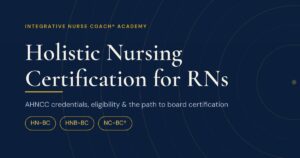
You need an active, unrestricted RN license. Board certification is not legally required to practice as a Nurse Coach, but it matters for credibility, for referral relationships, and increasingly for organizational contracts. The Nurse Coach Board Certified (NC-BC) credential from AHNCC requires an unrestricted RN license, a minimum of an associate degree, documented practice hours, 60 continuing nursing education hours, and 60 hours of supervised coaching experience. Our Nurse Coach certification guide walks through the full eligibility path, and you can read more on our board certification page.
Can a Nurse Coach diagnose or treat clients?
Not within the coaching relationship. Your nursing knowledge and assessment skills are fully present in your coaching, and they are what make you valuable. What you do not do as a coach is diagnose, prescribe, treat, or order and interpret lab work, unless you hold separate licensure to do so. Where exactly that line sits is defined by your own state's Nurse Practice Act, which is why Step 3 matters so much.
Is Nurse Coaching within an RN's scope of practice?
Health teaching, health counseling, and wellness promotion sit within RN scope in every state, and Nurse Coaching has its own published scope and competencies, affirmed by ANA. The specifics still vary, because scope is defined by your state's Nurse Practice Act rather than nationally. Read your own state's act, check your board's position statements, and document what you find. Use NCSBN's Nurse Practice Act lookup and its scope decision-making framework for anything ambiguous.
How much does it cost to start a Nurse Coaching business?
Most solo Nurse Coaches launch for under $1,000 in the first year, and many come in under $700. The main costs are state entity registration ($50 to $500), professional liability insurance that covers coaching ($200 to $500 per year), domain and hosting ($100 to $250 per year), and optionally an attorney review of your client agreement ($300 to $800 one time). An EIN from the IRS is free.
How much do Nurse Coaches charge?
Independent Nurse Coaches commonly charge from around $100 to $400 per hour, and many sell multi-session packages, often in the low thousands for a three-month engagement, rather than single sessions. Employed Nurse Coach salaries are frequently reported in the range of roughly $77,000 to $107,000 per year, depending on source, region, and experience. Rather than copying any of those numbers, work backward: take the annual income you need, add 25 to 30 percent for self-employment tax, add your business expenses, then divide by the sessions you can realistically deliver.
Do I need an LLC for a Nurse Coaching business?
Not strictly, and many begin as sole proprietors, but a single-member LLC is the common choice because it separates personal assets from business liabilities and costs relatively little to set up. What is not optional is separate business banking and coaching-specific liability insurance. Compare the options on the SBA's business structure page.
Do I need business insurance as a Nurse Coach?
Yes. Clinical malpractice coverage does not extend to coaching. Carry professional and general liability insurance written for Nurse Coaches or wellness professionals, typically a few hundred dollars per year. Ask your carrier in writing whether coaching is covered before your first paid session.
Can I run a Nurse Coaching business while working a clinical job?
Yes, and most Nurse Coaches start exactly that way. Check your employer's policy on outside employment and any non-compete language first. Then be realistic about capacity: two to four clients alongside full-time clinical work is a sustainable start, and it is enough to test your offer and your pricing with real people.
Can Nurse Coaches bill insurance?
RNs generally cannot bill insurers independently for coaching, and most successful Nurse Coaching practices are cash-pay. Some codes involve RN time when billed under a supervising provider within a practice, nurse practitioners have more options, and employer or organizational contracts are often a faster route to steady revenue than credentialing. See CPT codes for Nurse Coaches for the detail.
How long does it take to get my first paying client?
Nurses who finish their legal and pricing setup and then hold ten to fifteen genuine conversations per month usually land a first paid client between month two and month four. Building a practice that replaces meaningful clinical income typically takes twelve to twenty-four months of consistent effort. The number of conversations is the strongest predictor, not credentials.
What is the difference between a Nurse Coach and a health coach?
Both support behavior change, but a Nurse Coach is a licensed RN. That license brings clinical education, the ability to read clinical context, a statutory scope of practice, and through board certification pathways like the NC-BC, a recognized professional standard that general health coaches do not have. See the comparison table above.
Do I need social media to get clients?
No. Many Nurse Coaches build full practices on referral relationships, speaking, and email alone. Referral conversations with physicians, therapists, dietitians, and local practitioners are the highest-converting channel we see, and the most underused.
You have already done the harder part
You know how to coach. You know how to hold space for a person in the middle of a hard change, and you understand the clinical picture behind it in a way no lay coach ever will.
What is left is structure. A niche you can say out loud, scope you have confirmed in your own state, prices that hold up on a spreadsheet, an offer someone can buy, and a calendar with dates on it.
The people who need you cannot find you yet. That is the only problem left to solve.
Ready to build your practice?
You already learned to coach. This is how you turn that calling into a practice, ethically, sustainably, and on a real timeline.
Explore the course → Talk to admissions →Keep exploring
- What is a Nurse Coach, and how do you become one? →
- Nurse Coach Certification: the complete guide to earning your NC-BC →
- Nurse Coach salary: what the work actually pays →
- Integrating Nurse Coaching into Organizations & Communities →
- INCA accreditation and endorsements →
- Free Nurse Coach resources →
- Integrative Nurse Coach® Academy
- Integrative Nurse Coach® Academy
- Integrative Nurse Coach® Academy
- Integrative Nurse Coach® Academy