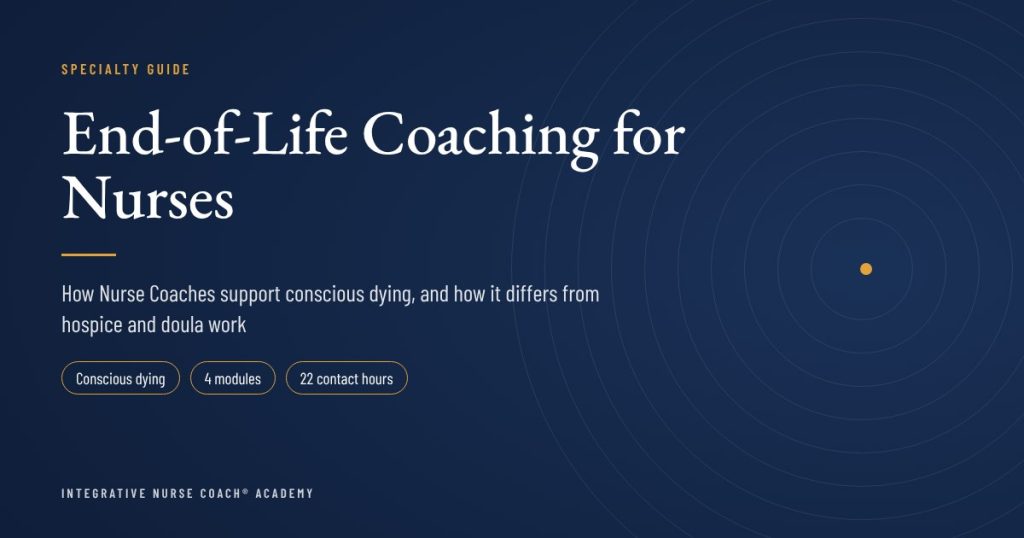

What end-of-life coaching is, how it differs from hospice nursing and doula work, what it looks like with a real family, and how nurses learn it.
End-of-life coaching is the use of Nurse Coaching skills (presence, skillful listening, significant questions, reflection and planning) with people living with serious illness and the people who love them, so that decisions about care and treatment are made within the framework of the person’s own life story. It can begin well before hospice, and it can change how people experience the last part of their lives.
- End-of-life coaching is a way of holding conversations, not a separate service line. Any nurse who works with chronic or advanced illness can use it.
- It differs from hospice nursing (clinical comfort care, usually in the last months) and from doula work (non-clinical companionship): the nurse brings clinical knowledge and a coaching process together.
- The skills are core Nurse Coaching skills: deep listening, discovering what matters most, co-planning and honoring readiness for change.
- INCA’s End-of-Life Coaching for Nurses course is 4 modules and 22 contact hours, self-paced, with 12 months to complete.
What is end-of-life coaching?
Many conversations about dying happen late: in a hospital room, under pressure, with the person least able to take part. End-of-life coaching moves them earlier. When a nurse works from a coaching perspective with someone living with chronic or advanced illness, the person and their family set goals based on what matters most to them, live more intentionally, and come to the final stage of life having already said much of what they wanted to say. A better conversation tends to lead to decisions that fit the person.
Conscious dying is the frame many of our faculty use: the idea that dying is something a person does, not only something that happens to them, and that it can be approached with the same awareness and intention as any other part of life.
Nurses who do this work often describe it differently than outsiders expect. One hospice nurse and Nurse Coach wrote that families sometimes tell her the job must be depressing, while her own experience is closer to this: “At hospice I get to help throw the farewell party.”
How does it differ from hospice nursing and doula work?
- Hospice nursing is clinical care for people with a life-limiting illness who have chosen comfort over cure, usually in the last months of life and wherever the person calls home. Many hospice nurses are Nurse Coaches; coaching shapes how they hold the conversations.
- End-of-life doulas are non-clinical companions who support the dying person and family through planning, vigil and the time after death. The Conscious Dying Institute is one of the organizations that educates them.
- End-of-life coaching is what a nurse brings to either setting: clinical knowledge, a place on the care team, and a structured coaching process. A Nurse Coach may do this inside hospice, in primary care or oncology, in a faith community, or in private practice with families.
What does it look like in practice?
Anne Bivins, RN, MSN, MBA, NC-BC, a hospice nurse manager and INCA graduate, described one family’s experience that shows the shape of the work. A brother and sister asked for help with their parents, both in their mid-eighties and living together in assisted living: the mother declining with cancer, the father living with dementia. The siblings did not want a nursing home and did not know what their parents needed to stay safe.
- First session, in person. Discovery and attentive listening to what both siblings wanted, and motivational interviewing to surface their feelings about end-of-life rituals for their parents. She checked for conflicting goals (there were none), then, with permission, offered care and service options and co-planned a family meeting with the parents and the facility staff.
- Second session, by phone, a week later. The daughter reported how the meeting went, named a new concern (the father trying to get his wife out of bed, not understanding her decline), and chose to add evening staff the father already trusted.
- Phone sessions every other week for two months. Listening and supporting the changes the siblings asked for. The mother died peacefully in the third month. The siblings said they felt empowered and that the goals they had set were met, and bereavement support for the father, the siblings and the staff was planned for the following year.
Anne named what coaching added to her hospice practice: deep listening, understanding the goal of the patient, family member or staff member, co-partnering and honoring readiness for change, cognitive reframing, and holistic practices for the team itself, such as guided imagery, journaling, a meditation to open each weekly meeting, and being present for each other. In her words: “We believe that when we are present for each other, we are more present for our dying patients and family members.”
How do nurses learn end-of-life coaching?
The coaching skills come first. The Integrative Nurse Coach® Certificate Program teaches them with supervised practice, and the Nurse Coaching skills guide explains what they look like in a session.
The End-of-Life Coaching for Nurses course is the specialty layer. It is written by Jan Booth, MA, RN, NC-BC, and built around her book Re-Imagining the End of Life: Self-Development and Reflective Practices for Nurse Coaches, recognized in the American Journal of Nursing’s Best Books of 2019 in the Professional Issues and Palliative Care and Hospice categories. The course is 4 modules and 22 contact hours, self-paced, with 12 months to complete. Its topics include:
- The Nurse Coaching model in end-of-life care
- Locating ourselves in the landscape of end-of-life care
- New possibilities and emerging models
- Mindful Nurse Coaching: resilience and self-care
- Learnings, goals and next steps
It is for nurses in any setting who work with aging, advanced illness or dying, and it begins by asking you to look at your own beliefs about them. If you are new to the role, start with what a Nurse Coach is. For your own resilience in this work, see what a healthy nurse looks like. INCA’s other specialty programs are listed in specialty courses for nurses.
Common questions
Is end-of-life coaching the same as being a death doula?
No. Doulas are non-clinical companions. A nurse using end-of-life coaching brings a nursing license, clinical knowledge and a coaching process, and can work as part of the care team.
Do I have to work in hospice to use it?
No. Primary care, oncology, cardiology, long-term care and faith communities all serve people living with advanced illness. The conversations belong wherever those people are.
Is the course only for Nurse Coaches?
It is written for nurses, with or without a coaching background. Nurse Coaches will recognize the model; other nurses learn it as they go.
How long is the course?
Four modules and 22 contact hours, self-paced, with 12 months from registration to complete.
Open the conversation earlier
End-of-Life Coaching for Nurses is self-paced, 22 contact hours from an ANCC-accredited provider, and built around reflective practice.
See the course → All specialty courses →Sources
- National Alliance for Care at Home. Hospice.
- Conscious Dying Institute.
- American Nurses Association. The Art and Science of Nurse Coaching, 2nd ed. (2021).
- Booth, J. Re-Imagining the End of Life: Self-Development and Reflective Practices for Nurse Coaches.

Janet Booth
Jan has focused her nursing career of over 34 years on quality of life and wellbeing, primarily through the lens of end-of-life care and health promotion. Within end-of-life care, her past nursing work includes inpatient hospice, palliative care within a major medical center, employee health and wellness for a large hospice organization, and community end-of-life education. Her wellness focus included work as a health educator, wellness trainer, and in wellness program development. Her current work is as an Integrative Nurse Coach® around the practice of wellbeing in aging, illness, and dying -- supporting people in navigating serious illness, helping families to talk more openly about end-of-life priorities, and providing health coaching for both professional and personal/family caregivers.
Jan has served as faculty for the International Nurse Coach Association | Integrative Nurse Coach® Academy's Integrative Nurse Coach® Certificate Program (INCCP) since 2014, and continues as faculty with the new and innovative online INCCP. With other INCA colleagues, she helped create an End-of-Life Nurse Coaching program in collaboration with the New York Open Center; and co-created an advanced training program for nurse coaches called Coaching Conversations for People Living with Chronic & Advanced Illness.
Jan also serves as faculty for end-of-life coaching and doula programs with the Conscious Dying Institute, and enjoys presenting at workshops and conferences around the country. She self-published a book for nurses and nurse coaches called Re-imagining the End of Life: Self-Development and Reflective Practices for Nurse Coaches,which was honored with the American Journal of Nursing’s “Best Books of 2019” award in the categories of Professional Development and Palliative Care.