
Whether you’re a bedside nurse, a nurse practitioner, a school nurse, or an RN exploring new possibilities — nurse coach certification can transform how you practice, how you connect with patients, and how you experience your own career. And you don’t have to leave your current role to use it.
Table of Contents
- What Is Nurse Coach Certification?
- Who Is Nurse Coach Certification For?
- NC-BC Certification Requirements
- How to Get Your NC-BC: Step by Step
- How Long Does Certification Take?
- What Does Certification Cost?
- The CPT Code: Why Certification Matters More Than Ever
- How Nurse Coaching Transforms the Nurse — Not Just the Practice
- What Comes After Certification?
- Next Steps
What Is Nurse Coach Certification?
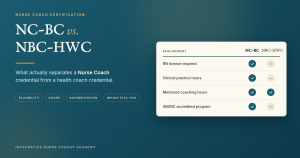
The Nurse Coach–Board Certified (NC-BC) credential is a national board certification offered through the American Holistic Nurses Credentialing Corporation (AHNCC). It validates that a registered nurse has completed advanced training in evidence-based coaching methods, holistic health approaches, and communication strategies designed to empower clients and patients toward lasting health outcomes.
The NC-BC is accredited by the Accreditation Board for Specialty Nursing Certification (ABSNC) and recognized by the ANCC Magnet Recognition Program — giving it weight with employers across healthcare systems nationwide.
If you’re looking for a deeper dive into what nurse coaches actually do day-to-day, INCA’s guide on what is a nurse coach covers the role in detail. This page focuses on the certification itself: the requirements, the process, and why this credential matters for nurses across every specialty.
Who Is Nurse Coach Certification For?
There’s a common misconception that nurse coaching is only for nurses who want to leave the hospital and start a private practice. While that’s absolutely one path — and a great one — the NC-BC is designed for a much wider audience.
Nurse coaching skills enhance the work of nurses in virtually every specialty and setting:
Nurses at the Bedside
If you work in acute care, med-surg, the ICU, or any inpatient environment, coaching skills change how you interact with patients during discharge education, chronic disease management conversations, and behavior change discussions. Instead of defaulting to “telling,” you learn to facilitate — which dramatically improves patient engagement and outcomes.
Nurses in Primary Care and Community Health
Coaching competencies like motivational interviewing and collaborative goal-setting are essential tools for nurses working in clinics, community health centers, public health departments, and outpatient settings where long-term behavior change is the goal.
School Nurses, Occupational Health Nurses, and Case Managers
These roles are already coaching-adjacent. The NC-BC formalizes the skills you’re already using intuitively and adds an evidence-based framework recognized by credentialing bodies.
Nurse Practitioners and Advanced Practice Nurses
Adding nurse coaching to an NP practice deepens the therapeutic relationship with patients and strengthens the prevention and wellness side of care that often gets squeezed in a 15-minute appointment.
Nurses Exploring Integrative and Holistic Modalities
If you’re drawn to approaches like functional nursing, lifestyle medicine, homeopathy, or end-of-life coaching, the NC-BC provides the foundational coaching credential that supports and complements those specializations.
Nurses Who Want to Build an Independent Practice
The NC-BC also opens the door to private practice, telehealth coaching, corporate wellness, and entrepreneurship. INCA maintains a dedicated nurse coach jobs page with current listings and salary data to help you explore what’s available.
Bottom line: Nurse coaching isn’t a departure from nursing. It’s an expansion of it — and the certification meets you wherever you are in your career.
NC-BC Certification Requirements
The AHNCC sets the eligibility criteria for the NC-BC exam. Here’s what you need:
Licensure
An active, unrestricted registered nurse (RN) license in the United States. Both ADN- and BSN-prepared nurses are eligible. (Wondering about LPN/LVN eligibility for coaching-related programs? INCA has a breakdown here.)
Clinical Experience
The required practice hours depend on your highest nursing degree:
- BSN or higher: Minimum 2 years full-time RN practice (or 4,000 part-time hours) within the past 5 years
- ADN or Diploma: Minimum 4 years full-time RN practice (or 8,000 part-time hours) within the past 7 years
Education
60 continuing nursing education (CNE) contact hours, accrued over the past 3 years, with content aligned to the Nurse Coach Core Values and Competencies.
Supervised Coaching Hours
60 hours of coaching practice supervised by a Certified Nurse Coach Supervisor, plus a validation letter from that supervisor.
The Exam
Once your application is approved by the AHNCC, you schedule your exam through the Center for Nursing Education and Testing (C-NET). The exam tests your knowledge of the Nurse Coach Core Practice Competencies.
How to Get Your NC-BC: Step by Step
1. Choose an AHNCC-Recognized Training Program
This is the decision that shapes your entire certification experience. You need a program that delivers both the 60 CNE contact hours and the 60 supervised coaching hours required by the AHNCC — and that genuinely prepares you for the depth of this work.
The Integrative Nurse Coach® Certificate Program (INCCP) at the Integrative Nurse Coach® Academy is one of the most established and comprehensive options available. Here’s what sets it apart:
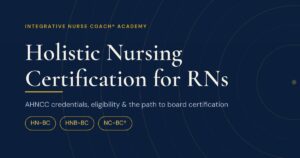
Dual certification eligibility. Completing the INCCP prepares you to sit for both the NC-BC exam and the Holistic Nurse–Board Certified (HN-BC) exam. Passing both earns you the Health and Wellness Nurse Coach–Board Certified (HWNC-BC) credential. Learn more about the board certification pathway →
ANCC accreditation. INCA is accredited as a provider of nursing continuing professional development by the American Nurses Credentialing Center’s Commission on Accreditation — the gold standard in nursing education. Read about INCA’s accreditation →
Integrative approach. The INCCP goes beyond standard coaching curriculum by incorporating mind-body practices, functional medicine concepts, reflective practice, and a deep focus on the nurse’s own health and self-development — because you can’t coach others toward well-being if you’re running on empty yourself.
Flexible, online format. The program is designed for working nurses. Small-group mentored sessions happen via live video with board-certified Nurse Coach faculty. Multiple cohorts start each year — check the course calendar for upcoming dates →
Built-in coaching practice. INCA provides access to a client database so students can connect with individuals seeking free coaching sessions. No scrambling to find practice clients on your own.
2. Complete Your Training and Supervised Hours
Throughout the INCCP, you accumulate your required CNE hours and supervised coaching hours as an integrated part of the program. The Practicum portion pairs you with experienced supervisors who review your coaching transcripts, observe sessions, and provide structured feedback.
This isn’t a checkbox exercise — it’s where real transformation happens. Students consistently report that the coaching practice and self-reflection components are the most impactful parts of the program.
3. Apply to the AHNCC
After completing your program, submit your application to the AHNCC with documentation of your nursing license, practice hours, education hours, and supervisor validation letter. Application fees range from $50–$100 depending on membership status.
4. Schedule and Pass the NC-BC Exam
Once approved, you’ll have 14 days to pay and schedule your exam. Exam fees range from $350–$425 depending on membership and program affiliation.
If you don’t pass on the first attempt, you can retake the exam within 12 months at a reduced rate of $225.
5. Maintain Your Certification
The NC-BC credential is valid for 5 years. Renewal requires 100 hours of continuing education or professional development within the certification cycle. INCA’s specialty nursing programs — including courses in functional nursing, lifestyle nursing, psychedelic care, and cannabis nursing — count toward renewal and allow you to keep expanding your scope.
How Long Does Certification Take?
If you already meet the licensure and practice hour requirements, the path from enrollment to board certification can be completed in approximately 7 months, depending on the training program and your pace. The INCCP offers cohorts starting throughout the year, so you can choose a start date that fits your schedule — no need to pause your current practice.
What Does Certification Cost?
Here’s a realistic breakdown of the investment:
Training program tuition varies by program. INCA offers scholarships, financial aid options, and military discounts to make the program accessible. Many nurses also use employer tuition reimbursement to cover part or all of the cost — INCA can help you navigate that process.
AHNCC application fee: $50–$100
NC-BC exam fee: $350–$425
For nurses interested in building an independent practice after certification, INCA provides community resources and mentorship to support the business development side of coaching. Visit Admissions & Financial Aid →
The CPT Code: Why Certification Matters More Than Ever
Nurse coaching now has its own Category III CPT code from the American Medical Association — a milestone for the profession. This code allows nurse coaches to bill for their services and begins the data collection process needed to eventually secure a permanent Category I code, which would open the door to broad insurance reimbursement.
This means nurse coaching is actively moving from a “nice-to-have” credential to a reimbursable healthcare service. For nurses considering certification, the implications are significant. Read more about CPT codes for nurse coaches →
How Nurse Coaching Transforms the Nurse — Not Just the Practice
One of the most underreported benefits of nurse coach certification is what it does for the nurse.
Burnout, compassion fatigue, and moral injury are not abstract concepts — they’re lived realities for a significant portion of the nursing workforce. Nurse coaching training doesn’t just teach you techniques for working with clients. It requires you to turn those same practices inward. Self-awareness, reflective practice, mindfulness, and intentional self-care aren’t optional extras in the INCCP — they’re core curriculum.
Graduates frequently describe the experience as transformative on a personal level. Not because they left nursing, but because they reconnected with why they became nurses in the first place.
Whether you stay at the bedside, move into leadership, open a private practice, or weave coaching into your existing specialty — the NC-BC changes how you relate to your work, your patients, and yourself.
What Comes After Certification?
The NC-BC is a starting point, not a ceiling. Many certified nurse coaches go on to deepen their expertise through specialized training. INCA offers a full suite of specialty nursing programs designed to complement the coaching credential:
- Functional Nursing — applying a functional medicine framework within nursing scope of practice
- Lifestyle Nursing — integrating lifestyle medicine principles into patient care
- Functional + Lifestyle Dual Certificate — the combined pathway for nurses who want both
- End-of-Life Coaching — supporting patients and families through life’s most difficult transitions
- Nursing Pathways in Psychedelic Care — emerging opportunities in psychedelic-assisted therapy
- Cannabis Nursing (CannyNurse®) — evidence-informed cannabis care for nurses
- Homeopathy for Nurses — classical homeopathy applied in nursing practice
These programs provide continuing education credits that count toward NC-BC renewal and allow you to develop a coaching niche that sets you apart.
Ready to Take the Next Step?
Nurse coach certification isn’t about choosing a different career. It’s about becoming a more holistic, more present, more empowered version of the nurse you already are — in whatever setting you choose.
Explore INCA’s programs:
- Integrative Nurse Coach® Certificate Program (INCCP)
- All Programs & Courses
- Admissions & Financial Aid
- Schedule a Call with an Admissions Specialist
Learn more about nurse coaching:
- What Is a Nurse Coach?
- Reasons to Become a Nurse Coach
- Board Certification Details
- Podcast: Integrative Nurse Coaches in ACTION!
- Free Nurse Coach Resources
- Download the INCA Course Catalog
About the Integrative Nurse Coach® Academy (INCA)
INCA is an ANCC-accredited provider and the leading educator in integrative nurse coaching. The Integrative Nurse Coach® Certificate Program prepares registered nurses for national board certification as both a Nurse Coach (NC-BC) and Holistic Nurse (HN-BC) through the AHNCC. With thousands of graduates worldwide, INCA is shaping the future of holistic, patient-centered care.

Ronald D. Kanka is the Chief Operating Officer of the International Nurse Coach Association and Integrative Nurse Coach® Academy (INCA), where he leads strategic growth, operational excellence, and innovation across the organization’s global programs.
With a background at the University of Miami Miller School of Medicine’s Integrative Medicine Division, Ronald built his foundation in healthcare education by managing large-scale continuing education initiatives in clinical nutrition, acupuncture, and complementary therapies. His work focused on creating high-impact learning experiences that brought together clinicians, educators, and thought leaders in integrative health.
In 2012, Ronald met INCA co-founder Susan Luck at a clinical nutrition conference—an encounter that would shape the trajectory of his career. He began working with INCA as a Program Manager and quickly became a driving force behind the organization’s expansion and evolution. Recognized for his strategic vision and operational leadership, he played a central role in transforming the Integrative Nurse Coach® Certificate Program from an in-person offering into a scalable, global online program—helping position INCA at the forefront of the nurse coaching movement.
As COO, Ronald oversees organizational strategy, program development, admissions and marketing systems, and operational infrastructure. His work has been instrumental in expanding INCA’s reach, strengthening its educational model, and supporting thousands of nurses worldwide in integrating holistic, mind-body-spirit approaches into their practice.
Ronald is deeply committed to advancing the future of nursing through innovation, systems thinking, and a more human-centered approach to care. His leadership continues to shape INCA’s role as a pioneer in bridging evidence-based practice with integrative and holistic health.